

In today's global economy, sustainability in the supply chain is no longer a nice-to-have; it's a necessity. Businesses that integrate sustainable practices not only reduce their environmental footprint but also drive cost savings, enhance brand reputation, and build long-term resilience. But how can companies implement sustainability smartly without disrupting efficiency? Let’s explore key strategies and best practices.
Sustainable sourcing: Choosing the right partners
The foundation of a green supply chain lies in sustainable sourcing. Companies should partner with suppliers who prioritize ethical labor practices, responsible material sourcing, and carbon footprint reduction. Certifications like Fair Trade (fairtrade.net) and Rainforest Alliance (rainforest-alliance.org) help businesses identify eco-conscious partners.
Eco-friendly packaging
Single-use plastics are a major environmental problem. Companies should transition to biodegradable, recyclable, or reusable packaging.
- Biodegradable Materials: Packaging made from materials like cornstarch, seaweed, and mushroom-based alternatives can break down naturally without harming the environment.
- Recyclable Solutions: Businesses should focus on using easily recyclable materials such as cardboard, glass, and certain plastics that can be reprocessed into new products.
- Minimalist Packaging: Reducing unnecessary packaging materials not only cuts costs but also decreases waste and shipping weight, lowering carbon emissions.
- Compostable Packaging: Some brands are opting for compostable mailers and wrappers that decompose quickly when disposed of properly.
- Water-based Inks & Non-toxic Adhesives: Traditional inks and glues can contain harmful chemicals. Switching to eco-friendly alternatives improves the recyclability and sustainability of packaging.
Brands like Loop (loopstore.com) offer innovative circular packaging solutions, reducing waste while keeping products fresh. Similarly, companies like Ecovative (ecovative.com) are developing mycelium-based packaging that is entirely biodegradable and sustainable.
However, sustainable packaging is just one piece of the puzzle. A truly sustainable supply chain requires an integrated approach that encompasses everything from raw material sourcing to end-of-life product management. If you're looking for an in-depth analysis of how businesses can achieve full supply chain sustainability, check out this comprehensive research overview (AIMultiple).
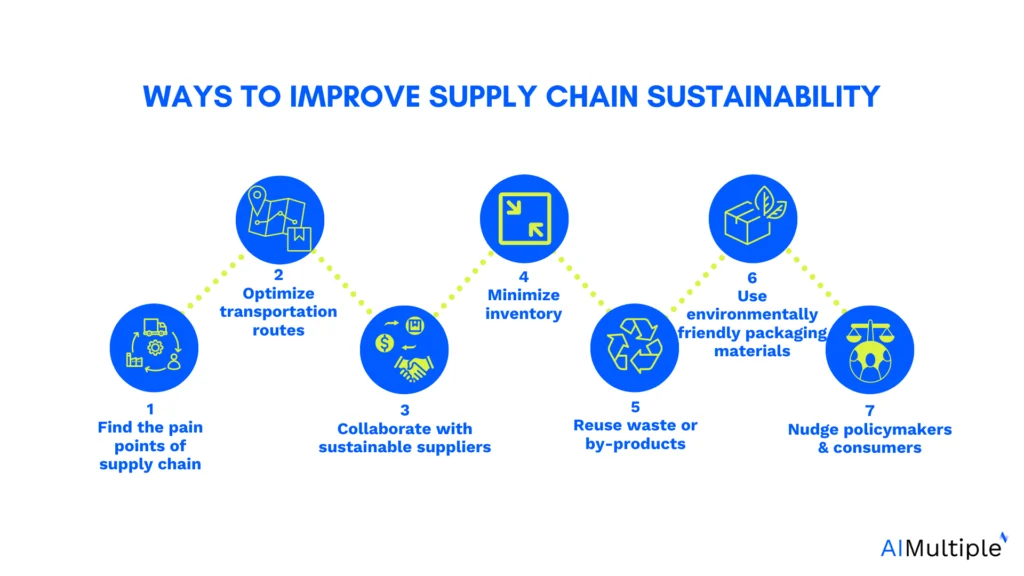
7 Ways to Improve Your Supply Chain Sustainability in 2025
Optimizing transportation & logistics
Transporting goods is a major contributor to carbon emissions. Businesses can lower their impact by:
- Utilizing electric or hybrid vehicles for deliveries.
- Optimizing shipping routes with AI-powered logistics platforms.
- Partnering with carriers that use sustainable fuels (Maersk’s green shipping initiative).
Energy-efficient warehousing & production
Manufacturing and storage facilities consume large amounts of energy. Solutions include:
- Switching to renewable energy sources like solar and wind.
- Implementing smart IoT devices to monitor and optimize energy use.
- Utilizing AI-driven inventory management to reduce overproduction and waste.
Circular economy & reverse logistics
A sustainable supply chain isn’t just about reducing emissions - it’s also about closing the loop. Companies can:
- Design products for easy recycling and reuse.
- Implement take-back programs (like Patagonia’s Worn Wear initiative wornwear.patagonia.com).
- Invest in remanufacturing and refurbishment programs.
Measuring and reporting sustainability progress
What gets measured gets improved. Companies should set clear KPIs for sustainability, such as:

- Carbon footprint per product.
- Percentage of recycled materials used.
- Reduction in water and energy consumption.
Leading frameworks like the Global Reporting Initiative (GRI) (globalreporting.org) and the Carbon Disclosure Project (CDP) (cdp.net) help businesses track and report their environmental impact.
Wrap-up
Smart sustainability is about balance - reducing environmental harm while maintaining efficiency and profitability. By making strategic changes in sourcing, logistics, packaging, and energy use, businesses can achieve a smaller footprint while making a bigger impact. Sustainability is no longer optional; it’s the new standard. The question is: Which of these strategies can your company implement today?
Literature
- Sustainable Supply Chain Strategy and Sustainable Competitive Advantage: A Mediated and Moderated Model: https://pmc.ncbi.nlm.nih.gov/articles/PMC9160660/
- Green and sustainable supply chain management in the platform economy: https://www.tandfonline.com/doi/full/10.1080/13675567.2022.2045763
- Sustainable Supply Chain Management: A Comprehensive Systematic Review of Industrial Practices: https://www.mdpi.com/2071-1050/14/13/7892
- Putting the S in Sustainable Supply Chain Management: A People-Centric Research Agenda: https://onlinelibrary.wiley.com/doi/10.1111/jscm.12337
- Mapping the trends of sustainable supply chain management research: a bibliometric analysis of peer-reviewed articles: https://www.frontiersin.org/journals/sustainability/articles/10.3389/frsus.2023.1129046/full
- Sustainable Supply Chain – a review of research fields and a proposition of future exploration: https://www.researchgate.net/publication/338038040_Sustainable_Supply_Chain_-_a_review_of_research_fields_and_a_proposition_of_future_exploration
- Multi-Objective Optimization for Sustainable Closed-Loop Supply Chain Network Under Demand Uncertainty: A Genetic Algorithm: https://arxiv.org/abs/2009.06047
- Green Supply Chain Network Design with Emphasis on Inventory Decisions: https://arxiv.org/abs/2104.05924